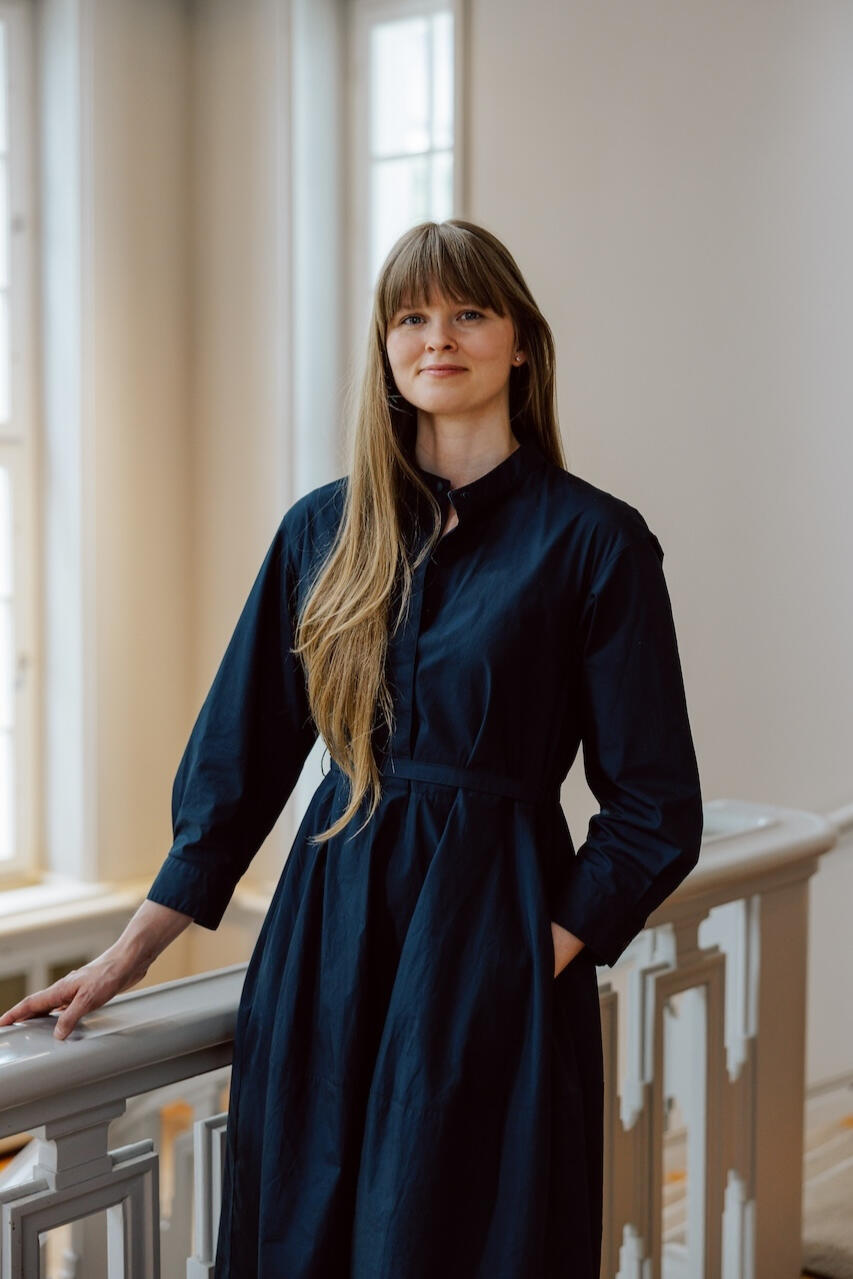
Dr. Kiersten Thamm is an art historian who studies what computation reveals, what it obscures, and how scholars can shape digital tools without losing the discipline’s attention to context, material knowledge, and interpretation.
Thamm examines how artwork, images, catalogues, and archives become structured data, and how art-historical judgments about classification, context, similarity, and authority are carried into computational systems. This work builds on her scholarship on materials, technology, ecological thought, and coloniality in twentieth-century design and architecture.As Head of Education and Communications at the nonprofit Navigating.art, she conducts and translates research into educational materials focused on digital stewardship, AI ethics in art-historical publication, and context-aware platform design. Her work helps art historians, collection specialists, and researchers understand and shape digital tools that support interpretation rather than replace it.
Select publications
ARTICLES AND REPORTS- “Digital Stewardship of Audiovisual Collections: Workflow Adaptation and Platform Development in Art Historical Research.” With Dana Anderson and Samantha Rowe. Journal of Digital Media Management 15 (2026).- “Context-Aware and Participatory Design for Computational Practice in Art History: A Case Study.” Digital Journal for Arts & Cultural Studies 3 (2026).- “Chain of Context: Ethical Use of AI Technologies in Art History Publications.” EU Horizon report, supported by the Wundercut Project, November 2025.- “Misunderstanding Familiar Objects in an Imagined Future: A Critical Method for Discovery.” On_Culture: The Open Journal for the Study of Culture 15 (2023).- “Politics and Politicization of the Chaises Sandows.” RADDAR, no. 3 (Autumn 2021): 80–101.BOOKS AND CHAPTERS- Contributing editor, Touching: Material as a Research Method. The Hague: Royal Academy of Art, 2022.- “Object as (Obscured) Archive: The Chaise Sandows.” In Fugitive Archives, edited by Sandy Isenstadt and Martin Brückner, chap. 8. Newark: University of Delaware Press, 2021.REVIEWS AND PUBLIC WRITING- “Book Review: Stephanie Schwartz, Walker Evans: No Politics.” History Network Review, January 2022.- “Book Review: Chris Millington, A History of Fascism in France.” History Network Review, March 2021.- “Practicing Utopia: The Mensch Meier Collective in the Time of COVID-19.” Platform, April 5, 2021.- “Review of Une Aventure Moderne: The Union des artistes modernes. Le Centre Pompidou, Paris.” Design and Culture 10, no. 2 (Autumn 2018): 139–41.
Select conferences and invited lectures
2027 — Forthcoming- The Value, Impact, and Ethics of Art Expertise. “Performing Expertise by Algorithm and by Archive: Power, Bias, and Purpose without Human Authentication.”2026- AI and Artworks: Object Detection, Image Classification and Iconographic Analysis, Österreichische Akademie der Wissenschaften. “Embedding-Based Image Analysis for Art Historical Research.”- Electronic Media and Visual Arts (EVA) Berlin, Brandenburg University of Technology Cottbus-Senftenberg and Fraunhofer Heinrich Hertz Institute. “When AI Falls Short, We Recalibrate the Social and Technical: A Case Study in Context-Aware Innovation for Art Historical Research.”- Catalogue Raisonné Scholars Association (CRSA). “Digital Asset Management Systems for Catalogues Raisonnés.”- Museums and AI Cultural Heritage, Loughborough University. “Sorted in Advance: AI and the Inherited Categories of Art Museum Collection Data.”2025- Association of American Appraisers Annual Conference. “Materials, Politics, and Industry of Art Deco.”- DAC Summer School: “AI Will Sort It…Out?,” University of Krems. “The Perils and Potential Rewards of AI in Digital Catalogues Raisonnés.”- Fourth International Artefacta Conference: Resolutions. “Resolving Material Conflicts in Contemporary Museums and Future Homes.” With Georgina McDowall.2024- Elegies of Waste, Surplus, and Excess, Technical University of Denmark. “Bewildering Things and Material Legacies: Recontextualizing Quotidian Objects in Stories from a Likely Future.”2023- Terms of Art, Hood Museum of Art, Dartmouth. “Leveraging the Authority of Labels to Align Design with Diverse Audiences.”- Society of Architectural Historians Annual Conference. “Uncovering Histories of Environmental and Social Impact.”- KW Institute for Contemporary Art, Berlin. “A Conversation with Karen Lamassonne about Memorializing Moments.”2022- Design History Forum, Drexel University. “Investigating Colonial and Immigration Histories of 1930s France through Steel and Rubber.”- Society for French Historical Studies. “Style Paquebot: Ocean Liners, the Steel Industry, and National Identity in Interwar France.”- College Art Association. “Reconsidering the Chaises Sandows: Materials, Makers, Industry, and Environments.”2021- Victoria and Albert Museum, Furniture History Society. “The O.T.U.A.’s Use of Chaises Sandows within Modern Publicity Practices.”2019- Historicising Masculinities Conference, Newcastle University. “The Men of L’Union des artistes modernes: Sustained Productivity of a Particular Homosociality across the Twentieth Century.”2018- Ecocriticism and Environmental Studies, London Centre for Interdisciplinary Research. “Mass Production as Nature and Nature as Mass Production.”- Berkeley/Stanford Symposium, SFMOMA. “Integration According to Herbst: Mass Production as Nature.”- College Art Association. “Masculine Comfort: Physical Culture, René Herbst, and the Chaise Sandows.”- Osher Lifelong Learning Institute, Wilmington, Delaware. “Sport, Design, and Politics.”2017- Graduate Student Forum, University of Delaware. “Institutional/Cripp/Queer Time at St. Elizabeths.”- Art History Graduate Student Symposium, Rutgers University. “Material, Structure, and a Queer Temporality at the Government Hospital for the Insane.”2016- The Refuge of Objects/Objects of Refuge Symposium, Universität Mainz. “The Chaises Sandows, René Herbst, and Psychological Repose.”- UCLA Art History Graduate Symposium. “Temporality and Structure at the Government Hospital for the Insane.”